
China’s Secret ‘Shenlong’ Space Plane Returns to Orbit: Why is the US Nervous?
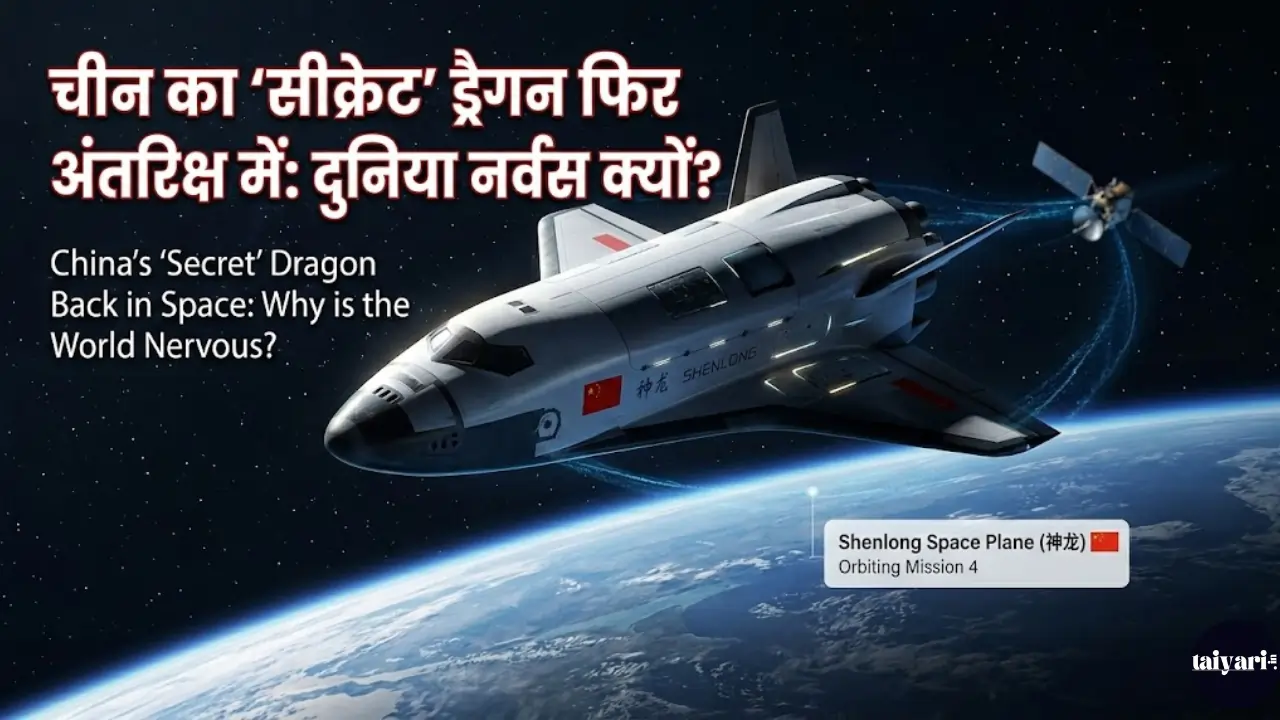
China’s ‘Divine Dragon’ Returns to Space: The Mystery of the Shenlong Space Plane
Space is no longer just a frontier for exploration; it has become a high-stakes arena for national security. Recently, China launched its highly secretive space plane, ‘Shenlong’, for the fourth time, sparking intense debate among global defense analysts.
What is the Shenlong Space Plane?
Shenlong is a Reusable Launch Vehicle (RLV). Unlike traditional rockets that are discarded after one use, Shenlong is designed to return to Earth and fly again.
- Launch: It is carried into space atop a Long March rocket.
- Orbit: Once in space, it functions like a satellite, circling the Earth at high speeds.
- Return: After completing its mission, it re-enters the atmosphere and glides down to land on a designated runway.
Why the ‘Secret’ Label?
The Chinese government provides very little data regarding the plane’s dimensions, cargo, or specific objectives. While official statements claim it is testing “economical methods for peaceful space use,” its orbital behavior tells a more complex story.
Why is the United States Concerned?
The US operates a similar craft, the X-37B. The primary concern isn’t just that the plane exists, but a capability known as RPO (Rendezvous and Proximity Operations).
During previous missions, tracking data from the US Space Force and private astronomers revealed that Shenlong released small objects into orbit and then performed maneuvers to fly very close to them.
The Strategic Risk: If a craft can fly close to its own “test objects,” it can theoretically fly close to an adversary’s satellite to:
- Inspect or Jam: Secretly photograph or electronic-jam sensitive equipment.
- Disable: Physically interfere with or remove a satellite from its orbit.
- Monitor: Intercept communication signals in real-time.
Can it Launch an Attack from Space?
There is a common fear that such planes could drop bombs from orbit. However, experts from the Secure World Foundation (SWF) suggest this is unlikely for now:
- Size Constraints: The craft is relatively small, leaving little room for heavy weaponry.
- Predictability: While it can stay up for months, its re-entry path is somewhat predictable, making it a poor choice for a “surprise” kinetic strike.
- Fuel Limits: Maneuvering extensively in space requires massive amounts of fuel, which limits its ability to act as a “space fighter.”
Conclusion: The New Era of Space Defense
The Shenlong mission proves that the “Space Race 2.0” is well underway. The focus has shifted from landing on planets to controlling the “High Ground” of Earth’s orbit. For any nation, protecting its satellite infrastructure is now as vital as protecting its borders.
Important Facts for Competitive Exams:
- Launch Site: Jiuquan Satellite Launch Center, China.
- US Equivalent: X-37B (developed by Boeing for the US Space Force).
- Key Tech: RPO (Rendezvous and Proximity Operations).
- Nature: Reusable Robotic Spaceplane.
Do you think India’s RLV-TD (Reusable Launch Vehicle) program should be fast-tracked to compete with such tech? Let us know in the comments!